
Plans people can read. Execution you can follow.
Work is written as a plan, approved by people, executed step by step by Orchestrator and followed in Helm. CIC is the plan format all three understand.
From an approved plan to a recorded result
Plans
Every piece of work is a plan: ordered steps, owners, checks and the documents people need. Plans are reviewed and approved before they run.
Orchestrator and Binnacle
Orchestrator executes each step under policy with rollback and an audit trail. Binnacle runs plans on a schedule or on demand.
Helm
Every step, start to finish, is reported to Helm. Leaders watch work happen live; auditors find the record afterwards.
One file holds the whole plan.
A CIC (Checklist In-Charge) file is a self-contained checklist: an outline of tasks with states, supporting documents and attachments, document control, and a complete history of every change. It is the plan format for Orchestrator and is built to be followed in Helm.
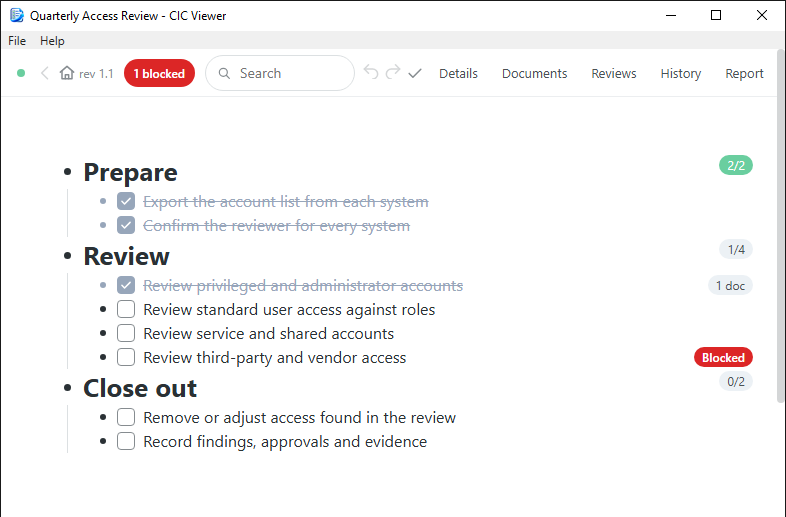
Tasks and states
Open, done, not applicable or blocked, with the reason. Progress counts tasks, not lines.
Supporting documents
Procedures and evidence attached to the steps that need them.
A history nobody can edit
Every change recorded with who and when.
Reviews that leave a record.
Each plan carries its own revision history, who approved each version, how often it must be reviewed and when the next review is due. Every review is logged with its date, result and everyone who took part, so the question "was this reviewed?" always has an answer.
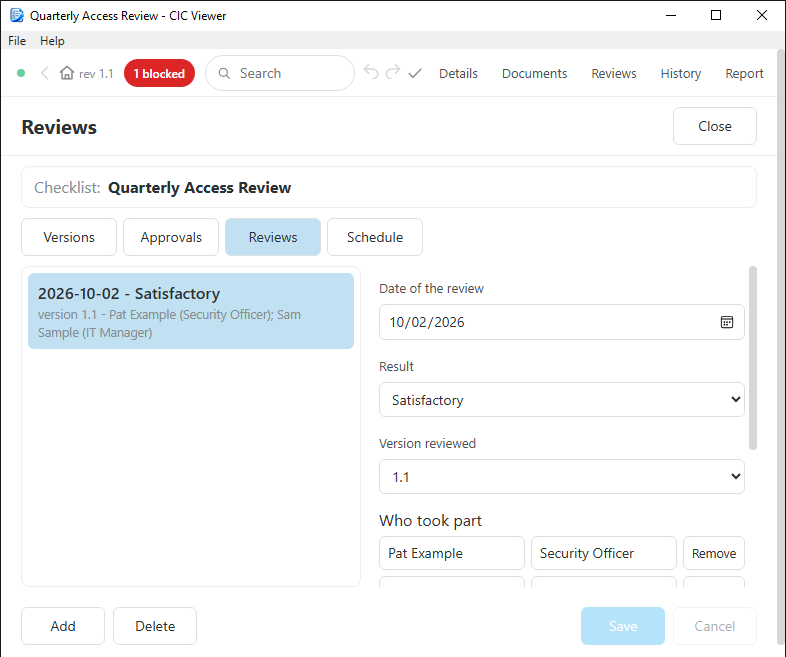
The same information appears in reports as a Document control section, ready for an auditor.
Decide once, check every time.
A plan keeps its facts as lists of typed values instead of a paragraph that says "write these down": the service name, a version, a URL, a token. Each value has a type and an explanation. Steps read them and fill them in, and each step, and the process as a whole, says what must be true before it is done.
Rules with a strength
A rule is a must, a should or a may. A must is absolute, a should can be gone past only with a recorded reason, and a may only informs.
Steps that prove themselves
A step carries its exit criteria and the commands to run. A runner executes them, the output is captured into values, and the criteria decide whether the step passed.
Secrets kept encrypted
A token one step obtains and a later step uses is stored encrypted for public keys. The plan holds only the public half, so anything can write a secret but only a holder of the private key can read it. Reports never show it.
Viewers and a command line
CIC Viewer
Open, edit and review plans. Searchable, with documents, attachments, history and reports built in. One file, nothing to install, no server.
cic command line
Create and change plans from scripts: add tasks, set states, attach evidence, record reviews, and list which checklists are due. Every change is one all-or-nothing batch.
Reports
Export any plan as a web page, Markdown or data, with documents, evidence and history, or place a snapshot into a Compliance Editor-In-Chief library.
A request, an approval and a complete trail.
Follow a recent demo from the ticket that proposed it, through the approval, to the live status page and the plan checklist, told by the person who asked for it.
Turn your next process into a plan.
Bring a recurring process and we will show it as a CIC plan, executed and followed end to end.
Request a briefing